|
|
F. Scott Fitzgerald
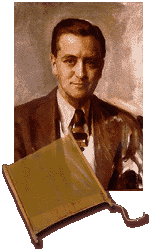
The 1920's, also known as the Jazz Age, were wild times, and Francis
Scott Key Fitzgerald was its king. Although he lead one of the most
wild and luxurious lifestyles of anyone during the decade, Fitzgerald
was known more for his prominent works of literature, which have
gained a permanent place among the American classics.
Fitzgerald was born on September 29, 1896 in St. Paul Minnesota.
His prename, Francis Scott Key, was given to him to honor his distant
ancestor who wrote the National Anthem. Fitzgerald's father, Edward
Fitzgerald, was from Maryland while his mother, Mary McQuillan, was
the daugher of an Irish-Catholic immigrant.
Fitzgerald entered St. Paul Academy when he was a boy, and started to
write for the school newspaper when he was thirteen. During 1911-1913,
he attended the Newman School, a Catholic Prep School in New Jersey.
There, he met Father Sigourney Fay, who encouraged him to pursue his
ambitions and to achieve personal success and distinction. Afterwards,
he entered Princeton University, where he grew on his writing abilities
by writing for school media. However, he neglected his studies and was
put on academic probation.
 In 1917, Fitzgerald joined the army to fight in World War I. In June
of 1918, he was assigned to Camp Sheridan in Alabama. There, he fell
in love with Zelda Sayre. After being turned down during a marriage
proposal due to his lack of success, Fitzgerald returned to St. Paul
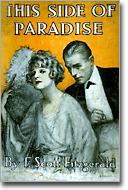
to begin work on his novel, This Side of Paradise.
In 1917, Fitzgerald joined the army to fight in World War I. In June
of 1918, he was assigned to Camp Sheridan in Alabama. There, he fell
in love with Zelda Sayre. After being turned down during a marriage
proposal due to his lack of success, Fitzgerald returned to St. Paul
to begin work on his novel, This Side of Paradise.
 In many ways The Beautiful and the Damned reflected the wild life of
Zelda and Fitzgerald
His novel was published in March of 1920, and he instantly became a
success. He had gained the kind of success and wealth that he had
desired for so long, and in a short time, he and Zelda married in New
York. He moved to an apartment in New York City where he wrote his
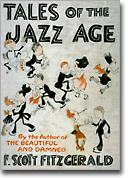
second novel, The Beautiful and the Damned.
In many ways The Beautiful and the Damned reflected the wild life of
Zelda and Fitzgerald
His novel was published in March of 1920, and he instantly became a
success. He had gained the kind of success and wealth that he had
desired for so long, and in a short time, he and Zelda married in New
York. He moved to an apartment in New York City where he wrote his
second novel, The Beautiful and the Damned.
After Zelda became pregnant in 1921, they settled down back in St.
Paul. And in October of 1921, their daughter, Frances Scott Fitzgerald,
was born. Luxurious parties and alcoholics bouts were common in the
Fitzgeralds' home, especially among Zelda, which triggered many
domestic rows.
In order to escape the distractions of New York, Fitzgerald moved to
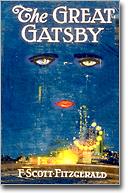
France in 1924 to work on his novel, The Great Gatsby . When the novel
was published in 1925, the sales were fairly disappointing, but theater
and movie deals brought in more income.
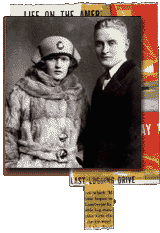 The Fitzgeralds returned to the United States in 1927, but Zelda's
unconventional behavior had become very eccentric. During 1930, Zelda's
physical and mental condition had deteriorated to the point where she
suffered a mental breakdown in April of 1930. She entered the Prangins
clinic to receive psychiatric treatment for her mental illness. As a
result, Fitzgerald had to suspend his novel writing to write short
stories to pay for her costly treatment.
The Fitzgeralds returned to the United States in 1927, but Zelda's
unconventional behavior had become very eccentric. During 1930, Zelda's
physical and mental condition had deteriorated to the point where she
suffered a mental breakdown in April of 1930. She entered the Prangins
clinic to receive psychiatric treatment for her mental illness. As a
result, Fitzgerald had to suspend his novel writing to write short
stories to pay for her costly treatment.
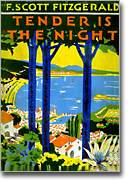
In 1934, Fitzgerald's final attempt at a hit novel, Tender Is the Night
, was published in hopes that he could earn enough for Zelda and his
daughter. However like The Great Gatsby, its sales were disappointing.
And by 1936, Fitzgerald was ill, drunk, and in debt. So he headed off
to Hollywood in 1937 hoping to become a prominent screenplay writer.
However, the only screen credit he received was for the film, Three
Comrades.
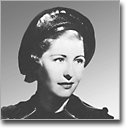 After failing in Hollywood, Fitzgerald fell in love with the young
columnist, Sheilah Graham. After MGM dropped his options in 1938,
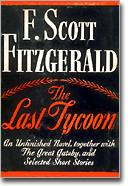
Fitzgerald returned to novel writing. He had worked on The Love of the
Last Tycoon, but Fitzgerald died from an unfortunate heart attack in
Sheilah's apartment on December 21, 1940.
After failing in Hollywood, Fitzgerald fell in love with the young
columnist, Sheilah Graham. After MGM dropped his options in 1938,
Fitzgerald returned to novel writing. He had worked on The Love of the
Last Tycoon, but Fitzgerald died from an unfortunate heart attack in
Sheilah's apartment on December 21, 1940.
Although Fitzgerald's writing was not considered to be of high quality,
because of the long held belief that he was an irresponsible writer.
But then during the late 1940's, a revival of Fitzgerald's works made
both him and his works more appreciated. And by the 1960s, Fitzgerald
had secured a place in literary history as one of the most prominent
writers ever.
Fitzgerald's Novels